
Tools
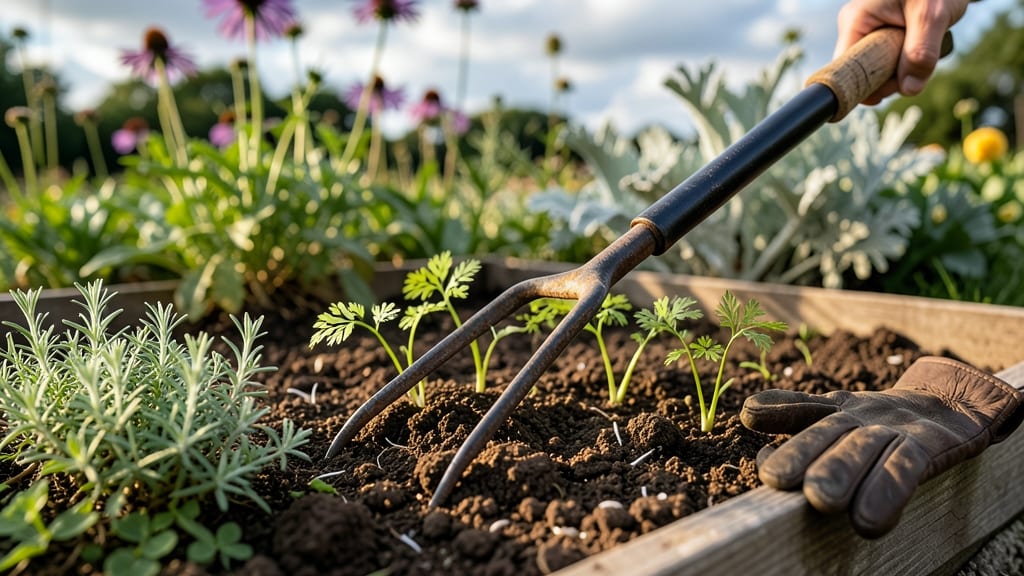
A garden cultivator is used for loosening compacted soil, uprooting weeds, aerating root zones, breaking up hard clumps, and creating smooth seedbeds—tasks it handles far more efficiently than a rake, especially in large or rocky garden areas. The rotating tines dig vertically and horizontally for deep soil prep.
A garden cultivator transforms your soil prep game by tackling what rakes simply can't: deep compaction and stubborn debris. 🌱 The spinning tines slice through hardpan layers while lifting weeds by their roots, not just chopping them at the surface.
I've found this makes all the difference when planting heavy feeders like tomatoes or roses—those roots get the space they need to thrive. Plus, the adjustable depth settings let you customize for delicate flower beds or tough clay soil without risking root damage.
Think of it as your soil's personal masseuse: it relieves pressure, improves drainage, and creates the ideal crumbly texture for seeds or transplants. Unlike rakes that just scratch the surface, cultivators reach down to where it matters most.
For best results, run it at a shallow angle first to loosen the top layer, then go deeper for stubborn areas.
💡 In This Article
- How Rotating Tines Outperform Rakes in Soil Aeration
- Best Cultivator Tasks for Vegetable Gardens and Flower Beds
How rotating tines outperform rakes in soil aeration
The key difference between a garden cultivator and a rake lies in their mechanical action. Cultivator tines rotate at 1,500-3,000 RPM, creating a scissor-like motion that slices through soil vertically and horizontally. This contrasts with rakes that only scratch the surface in one direction, leaving compaction intact.
The spinning action breaks up hardpan layers—those dense, impermeable soil zones—by physically disrupting the soil matrix down to 6-8 inches deep, depending on the model.
This vertical penetration is what gives cultivators their edge, especially in clay or hardpan soil. When you run the tines through compacted ground, they create tiny air channels that improve oxygen flow to roots—a process called soil aeration.
Studies show aerated soil can increase root growth by up to 40% compared to undisturbed compacted soil.
The tines also lift weeds by their roots rather than just chopping them at the surface, which means fewer regrowth cycles. 🌱 For comparison, a standard rake might loosen only the top 1-2 inches of soil, leaving deeper compaction untouched.
The rotating motion also creates a fine, crumbly texture ideal for seedbeds. Unlike rakes that can create uneven ridges, cultivators blend soil uniformly while incorporating organic matter. This is particularly useful for preparing beds for carrots or radishes, where smooth, loose soil prevents forked roots.
The adjustable depth settings on most cultivators let you fine-tune penetration—shallow for flower beds (1-2 inches) or deeper for vegetable gardens (4-6 inches)—without risking root damage that can occur with manual digging.
What most gardeners don't realize is how cultivators handle rocky soil differently. The tines don't get bogged down like rakes do—they simply pivot around larger stones while still breaking up the surrounding soil.
This makes them ideal for preparing beds in areas with 10-20% stone content, where rakes would struggle to make progress. The continuous rotation also prevents the soil from settling back into compacted layers immediately after tilling, unlike with rakes that require multiple passes to achieve similar results.
For clay-heavy soils, the cultivator's action is particularly transformative. Clay particles tend to bind tightly when wet, creating a dense barrier that roots can't penetrate. The cultivator's tines break these bonds by physically separating the clay platelets, improving water infiltration by up to 30%.
This is why professional gardeners often use cultivators before planting in clay soils—they turn the heavy, sticky medium into a workable, friable texture within minutes. The result? Plants establish roots more quickly and withstand drought better.
Consider this real-world example: When preparing a 10x10-foot garden bed for tomatoes, a cultivator with 8-inch-wide tines will complete the job in about 10-15 minutes, compared to 45-60 minutes with a rake.
The cultivator also leaves the soil in a more uniform condition, ready for planting immediately, while rake-prepped soil often requires additional leveling. This efficiency is why cultivators are the tool of choice for both home gardeners and commercial farms alike. ✨