
Tools
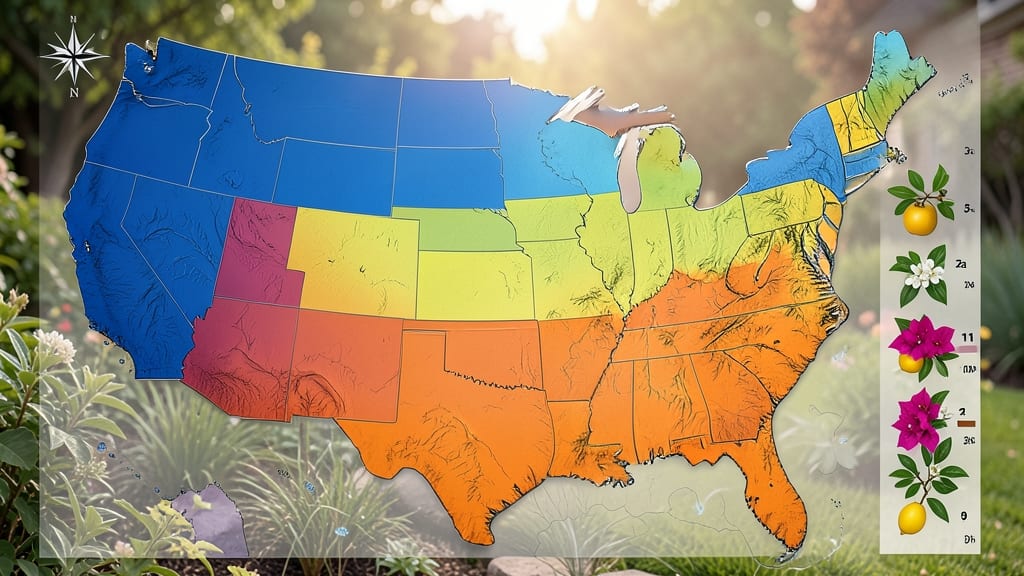
Finding your US gardening zones helps you select plants that thrive year-round in your climate. Use the USDA Plant Hardiness Zone Map to identify your exact zone number and pair it with suitable crops and flowers.
Understanding your US gardening zones is like having a climate guidebook for your garden.
The USDA Plant Hardiness Zone Map divides the country into 13 zones based on average minimum winter temperatures, which directly impacts what plants can survive in your area. 🌱 For example, Zone 3 (coldest) allows hardy perennials like coneflowers, while Zone 10 (warmest) thrives with citrus trees and bougainvillea.
Microclimates—like sunny south-facing walls or shaded garden nooks—can even shift your effective zone by a few numbers, so always test your local conditions before planting.
Once you know your zone, you can match plants to your region's growing season. Cool-season crops like broccoli grow best in Zones 3-7, while heat-loving vegetables such as okra thrive in Zones 8-11.
Native plants often require minimal care because they're already adapted to your zone's conditions, making them the easiest choice for beginners.
💡 In This Article
- How USDA Plant Hardiness Zones Work
- Top Plants for Each US Gardening Zone
How USDA plant hardiness zones work
The USDA Plant Hardiness Zone Map divides the country into 13 zones based on the average annual minimum winter temperature—the coldest temperature plants can survive.
Each zone represents a 10°F range, with Zone 1 being the coldest (-60°F to -50°F) and Zone 13 the warmest (70°F to 80°F). This system helps gardeners predict which plants will thrive without dying from frost or heat stress.
For example, a Zone 5 garden (-20°F to -10°F) can support hardy perennials like peonies, while Zone 10 (30°F to 40°F) allows tropical plants like hibiscus to flourish year-round. 🌡️
Zone boundaries are drawn based on 30-year climate averages, which means your local zone might shift slightly over time due to climate change. The USDA updates the map every 10 years to reflect these changes.
Within each zone, microclimates further refine planting success—south-facing slopes warm up faster, while shaded areas stay cooler. A garden bed near a brick wall might be 2-5°F warmer than the surrounding area, effectively shifting your planting zone by one level.
This is why gardeners in transitional zones (like Zone 6b/7a) often experiment with cold-hardy varieties to test their garden's limits.
Understanding these zones isn't just about winter survival—it also dictates growing seasons. Plants in Zone 3 (-40°F to -30°F) have a shorter growing window compared to Zone 9 (20°F to 30°F), where frost-free periods last nearly year-round.
This affects everything from seed-starting dates to harvest timing. For instance, tomatoes in Zone 3 need to be started indoors 6-8 weeks before the last frost, while Zone 9 gardeners can plant them as late as April or May without risking frost damage. 🌱
Zone maps also account for plant hardiness, which measures a plant's tolerance to cold snaps. A Zone 5 plant labeled "hardy to Zone 4" can survive colder winters than its zone suggests, while a Zone 7 plant might struggle in Zone 6 if exposed to unexpected -15°F temperatures.
This flexibility is why gardeners often "push the envelope" by planting marginally hardy varieties—like growing roses in Zone 5 when their label says Zone 6—with protective measures like mulch or winter blankets.
For urban gardeners, city heat islands can create unexpected zone shifts. Pavement and buildings absorb and radiate heat, making downtown areas 5-10°F warmer than surrounding rural zones. This means a rooftop garden in Zone 6 New York City might experience conditions more like Zone 7.
Always verify your exact location using the USDA Interactive Zone Finder, which accounts for elevation and local topography. A 1,000-foot elevation gain can drop temperatures by 3.5°F per 1,000 feet, potentially shifting your zone by a full number.
Finally, zone maps don't tell the whole story—soil type, sunlight exposure, and water availability play equally critical roles.
A Zone 8 garden with poor drainage might struggle with heat-loving plants like bougainvillea, while a Zone 5 garden with rich, moist soil could support marginally hardy varieties like hostas that typically thrive in Zone 4. The best approach?
Use zones as a starting point, then observe how your specific garden behaves over multiple seasons. 💡