
Companion Plants
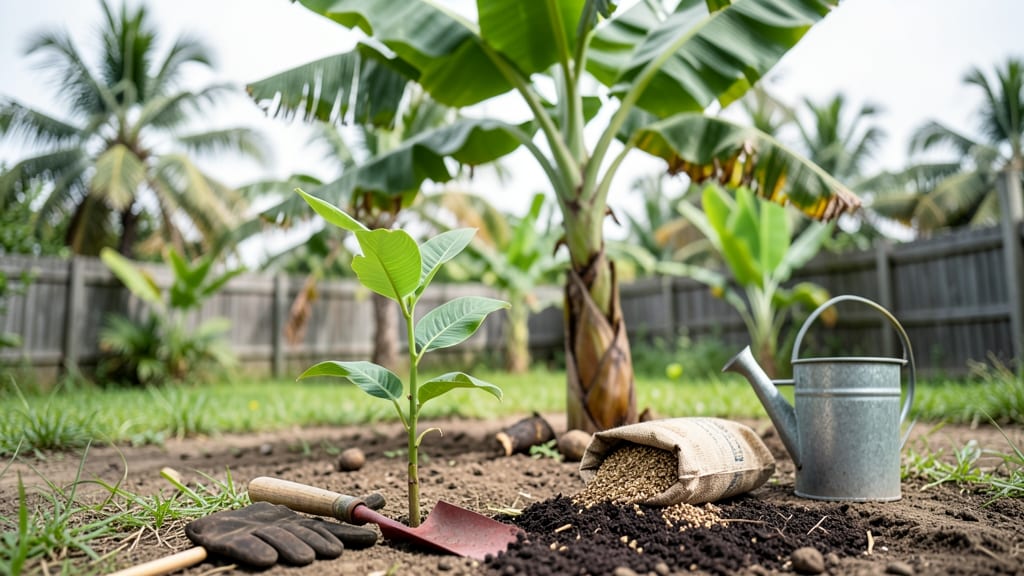
What happens when you plant a banana in your garden? You're introducing a dramatic tropical perennial that develops massive leaves, stores nutrients in its pseudostem, and produces edible fruit clusters after 2-5 years. Its aggressive root system demands ample space and consistent moisture to thrive, but it only succeeds in frost-free climates.
This isn't just about growing fruit—banana plants are architectural statement pieces in your garden. 🌿 The pseudostem (what looks like the trunk) is actually tightly packed leaves that store energy for growth, while the roots can spread up to 15 feet wide.
What many gardeners don't realize is that bananas are technically berries, and their flowering process begins only after the plant reaches maturity—usually when it has 10-12 large leaves unfurled.
The key to success is mimicking their native tropical environment: warm temperatures, high humidity, and well-draining soil with plenty of organic matter.
Here's the catch: these plants are heavy feeders. They'll reward you with 50-100 pounds of bananas per harvest if given proper care, but they'll also deplete your soil quickly. Many gardeners repurpose the old pseudostem as mulch or propagation material for new plants after harvest.
And if you're in a cooler climate? Don't worry—you can still grow them in containers and bring them indoors during winter!
💡 In This Article
- Banana Plant Growth Stages and Developmental Biology
- Climate and Soil Requirements for Growing Bananas
Banana plant growth stages and developmental biology
The banana plant's growth begins with a pseudostem—a false trunk made of tightly wrapped, overlapping leaf sheaths that store nutrients and water. Unlike true stems, this structure lacks vascular tissue but acts like a reservoir, allowing the plant to grow up to 30 feet tall in ideal conditions.
The roots, which can spread 15 feet wide, develop a symbiotic relationship with mycorrhizal fungi in the soil, enhancing nutrient absorption. This aggressive root system explains why banana plants need 6-10 feet of space between each plant.
Leaf development follows a precise pattern: each new leaf unfurls from the center, growing 3-4 feet per day during peak growth. The plant reaches maturity when it produces its 10th-12th leaf, signaling the beginning of the flowering process.
What most gardeners don't realize is that bananas are technically berries—each "fruit" is actually a cluster of tiny individual fruits fused together.
The flowering inflorescence emerges from the center of the plant and can weigh up to 100 pounds when fully developed, with hand-length bananas forming in clusters called "hands."
Temperature plays a critical role in this process. Banana plants require consistent warmth (70-90°F) to thrive—they'll stop growing below 50°F and die with frost exposure. Light intensity affects leaf size and fruit quality: bright, indirect sunlight produces larger leaves and sweeter bananas, while direct midday sun can scorch delicate foliage.
The fruit development timeline spans 90-150 days after flowering, with harvestable bananas appearing in 3-5 months depending on the variety.
Here's a fascinating detail: the plant dies after fruiting, but not before. The pseudostem continues supplying nutrients to the developing fruit until harvest. What most people overlook is that the mother plant produces 1-3 "pups" (offspring plants) at its base, which can be transplanted to continue the cycle.
These pups inherit the mother plant's genetic traits, ensuring consistent fruit quality if propagated from healthy stock. 🌱
Consider these key growth factors that differentiate banana plants from other tropical crops:
- Nutrient demand: Requires 3-4 times more potassium than most vegetables, with ideal soil ratios of 1:2:1 (N-P-K)
- Water needs: Prefers 1-2 inches of water weekly, but roots must never sit in water (root rot is a common killer)
- Light sensitivity: Young plants need partial shade to prevent leaf burn, while mature plants tolerate full sun
The flowering process itself is triggered by a combination of plant maturity and environmental cues. When the plant reaches 10-12 leaves, it begins producing a hormone called florigen that signals the inflorescence to develop.
This is why some gardeners report flowering failures in cooler climates—the plant may never reach this hormonal threshold without proper warmth. Once flowering begins, the process is irreversible, and the plant will focus all its energy on fruit production rather than new leaf growth. 🌿