
Advice
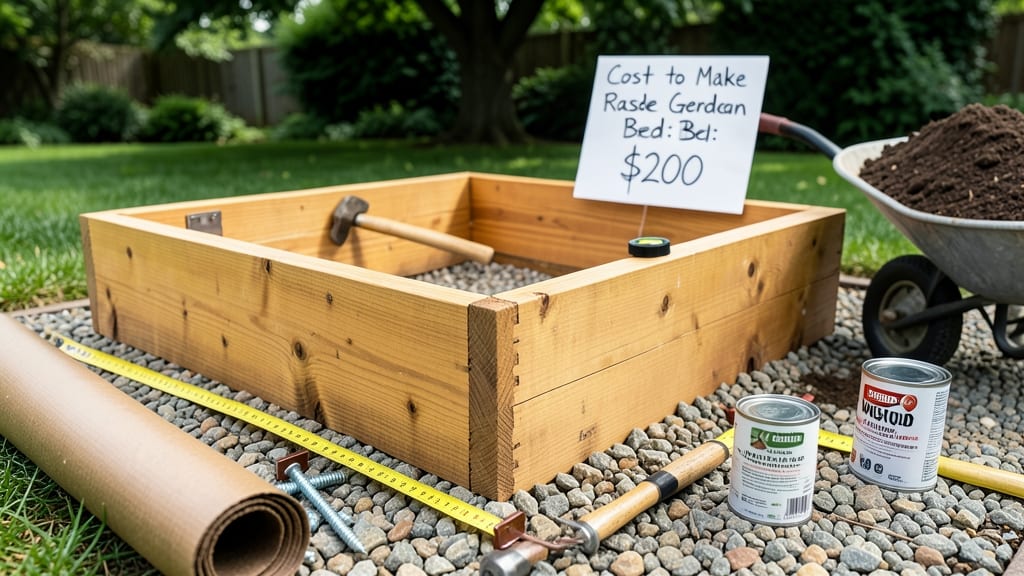
The cost to make a raised garden bed typically ranges from $200–$1,500+, influenced by size (4’x8’ vs 8’x12’), lumber choice (cedar, redwood, or composite), and soil quality. A standard 4’x8’ cedar bed costs $300–$600, while elaborate designs with trellises or irrigation systems push costs to $500–$1,500+. DIY approaches and salvaged materials can slash expenses by 30–50%
The price swings wildly based on what you prioritize—durability, aesthetics, or functionality. 🌿 For instance, cedar resists rot but costs more than pressure-treated pine, while composite lumber lasts decades but doubles the upfront cost.
Smaller beds (4’x4’) start as low as $150 with basic pine framing, but deeper beds (12"+) require extra soil and structural reinforcement, adding $100–$300. I’ve seen gardeners save hundreds by sourcing free pallet wood or repurposing old fencing, though these require extra sealing to prevent warping.
Another key factor is soil prep—pre-mixed garden soil can run $50–$100 per cubic yard, while DIY blends of compost and topsoil cut costs by nearly half. If you’re planning for long-term use, investing in thicker lumber (2x12s instead of 2x6s) upfront can prevent costly repairs down the road.
The right balance depends on whether you’re growing flowers, veggies, or herbs—each has different soil depth needs.
💡 In This Article
- Raised Garden Bed Cost Breakdown by Material and Size
- Ways to Reduce Raised Garden Bed Costs Without Sacrificing Quality
Raised garden bed cost breakdown by material and size
Lumber choice is the single biggest cost driver in your raised bed budget. Cedar planks cost $3–$6 per board foot and resist rot naturally, while pressure-treated pine runs $1.50–$3 per board foot but requires sealing to prevent chemical leaching.
Composite lumber (like Trex) starts at $8–$12 per board foot but lasts 20+ years—ideal for high-traffic areas. For a 4’x8’ bed with 12” sides, cedar framing costs $250–$400, while composite jumps to $600–$900.
The deeper your bed (12” vs 6”), the more lumber you need, adding $100–$200 to materials.
Bed dimensions directly impact material volume and soil requirements. A 4’x8’ bed uses about 10 board feet of lumber, while an 8’x12’ bed requires 30+ board feet. Soil depth matters too: 6” of fill costs $50–$100 for a 4’x8’ bed, but 12” doubles that.
The weight difference also means you’ll need sturdier corners—galvanized metal brackets ($10–$20 each) or concrete blocks ($5–$15 each) instead of basic screws. 🌱 For example, my 6’x12’ cedar bed with 12” depth cost $750 in lumber alone, plus $200 for soil and hardware.
Labor costs vary wildly—DIY saves $300–$800, while professional assembly runs $500–$1,500 for complex designs. If you hire help, expect $50–$100/hour for framing and $20–$40/hour for soil delivery.
The time investment isn’t trivial: A 4’x8’ bed takes 4–6 hours to build from scratch, while larger beds can stretch to 10+ hours. I’ve seen gardeners rush assembly and need to replace warped wood within a year—always use 2x12s for sides to prevent sagging over time.
Long-term durability depends on material science. Cedar contains natural oils that repel moisture, but it warps if not properly dried (look for kiln-dried labels). Pressure-treated wood contains chromated copper arsenate (CCA), which can leach into soil—opt for ACQ-treated instead for edible gardens.
Composite lumber won’t rot but can crack under extreme temperature shifts. For climate zones with freeze-thaw cycles, add $50–$100 for expansion joints or flexible connectors. 💡 Pro tip: Stagger end joints in your framing to prevent water pooling at seams.
Soil quality affects both upfront and long-term costs. Pre-mixed garden soil costs $50–$100 per cubic yard, but DIY blends of 50% compost, 30% topsoil, and 20% perlite cut costs by 40%. Heavy clay soil requires $100+ in amendments, while sandy soil needs organic matter to retain moisture.
Test your native soil first—amending it properly can save you $200+ in replacement soil over time. For example, my neighbor spent $800 on pre-mixed soil for her 8’x12’ bed, while I used $300 worth of compost and local topsoil with identical results.
Don’t overlook hidden costs like drainage. If your site has poor drainage, add $50–$150 for landscape fabric or gravel layers. For raised beds over 4’ wide, consider $100–$200 in cross-bracing to prevent tipping.
The right foundation—whether gravel, pavers, or deck blocks—can add $100–$300 but extends your bed’s lifespan by 5–10 years. 🌿 For instance, my cedar bed on gravel foundation shows no rot after 7 years, while a friend’s bed on bare soil needed replacement after 3 years.