
How To
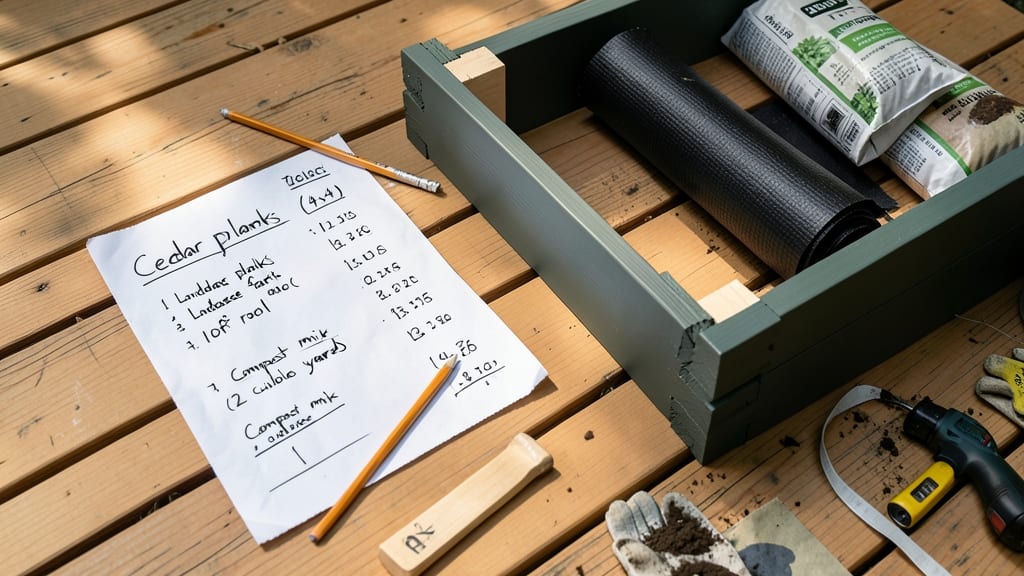
The cost to build a raised garden bed ranges from $150 to $600 total, based on your chosen dimensions (4x8 ft to 8x12 ft), lumber type (cedar vs composite), and how much soil you need to fill it. Smaller 4x2 ft beds start around $100-$200, while larger 8x12 ft beds easily surpass $500.
The total cost depends heavily on the materials you select and the size of your project. 🌱 Cedar planks are popular for their natural resistance to rot, but they cost more upfront than pressure-treated lumber. Composite lumber offers durability without the maintenance, though it comes with a higher price tag.
Don't forget to budget for soil—high-quality garden mix can add $50-$150 to your total depending on how deep you build the bed. Many gardeners also factor in hardware costs for screws and corner brackets, which typically run $10-$30 depending on the quality.
For example, a 4x8 ft bed using cedar lumber might cost around $250-$350, while switching to composite lumber could push that to $400-$500. The good news is that these beds last for years, making them a cost-effective investment compared to yearly soil and fertilizer expenses in traditional in-ground gardens.
💡 In This Article
- Raised Garden Bed Cost Factors by Material Type
- Size-Based Cost Estimate for DIY Raised Beds
Raised garden bed cost factors by material type
Your choice of lumber directly impacts both upfront cost and long-term durability. Cedar planks, a popular choice, cost $4-$8 per linear foot due to their natural rot resistance and aromatic qualities. Redwood, another premium option, runs $5-$10 per foot but offers superior longevity in wet climates.
Pressure-treated lumber is the budget-friendly alternative at $2-$5 per foot, though it requires sealing every 1-2 years to prevent chemical leaching and wood splintering.
The most significant cost jump comes with composite lumber, which ranges from $8-$15 per foot. These materials mimic wood's appearance but resist moisture, insects, and warping entirely. For example, a 4x8 ft bed built with cedar costs roughly $160-$240 for lumber alone, while composite would cost $320-$480—nearly double.
The trade-off? Composite beds require zero maintenance beyond occasional cleaning, saving $50-$100 every few years compared to cedar's annual sealing needs.
Recycled materials offer another cost-effective path, with reclaimed wood often available for $1-$3 per foot. However, these lack consistent dimensions and may require extra cutting time. The environmental benefit comes with a practical downside: uneven planks can create gaps where weeds grow or soil spills out.
For a 8x12 ft bed, recycled lumber could cut costs by $200-$300 compared to new cedar, but you'll spend 2-3 extra hours leveling and securing the frame.
Don't overlook hardware costs—galvanized screws ($0.50-$1 each) prevent rust better than basic nails ($0.20-$0.40 each). Corner brackets add $5-$15 per corner but eliminate the need for complex joinery.
A 4x8 ft bed might need 16 screws and 4 brackets, adding $10-$30 to your total. The right hardware can extend your bed's lifespan by 30-50% through better structural integrity.
Soil quality plays a hidden role in material selection. Cedar's natural oils repel moisture, making it ideal for beds filled with 12-18 inches of soil—where moisture retention becomes critical. Composite beds, meanwhile, can handle 24-inch fills without risk of rot, though the deeper soil requires $100-$200 more in garden mix.
The right material-soil pairing can reduce long-term watering costs by 40% through improved drainage and moisture control.
Consider this real-world example: A 6x6 ft cedar bed with 12-inch soil depth costs $220 total, while the same size in composite with 18-inch soil jumps to $450. However, the composite bed lasts 15+ years with no maintenance, while the cedar may need replacement in 8-10 years.
Factor in $15/year for cedar sealing, and the composite becomes cost-competitive after 5 years. 💫