
Advice
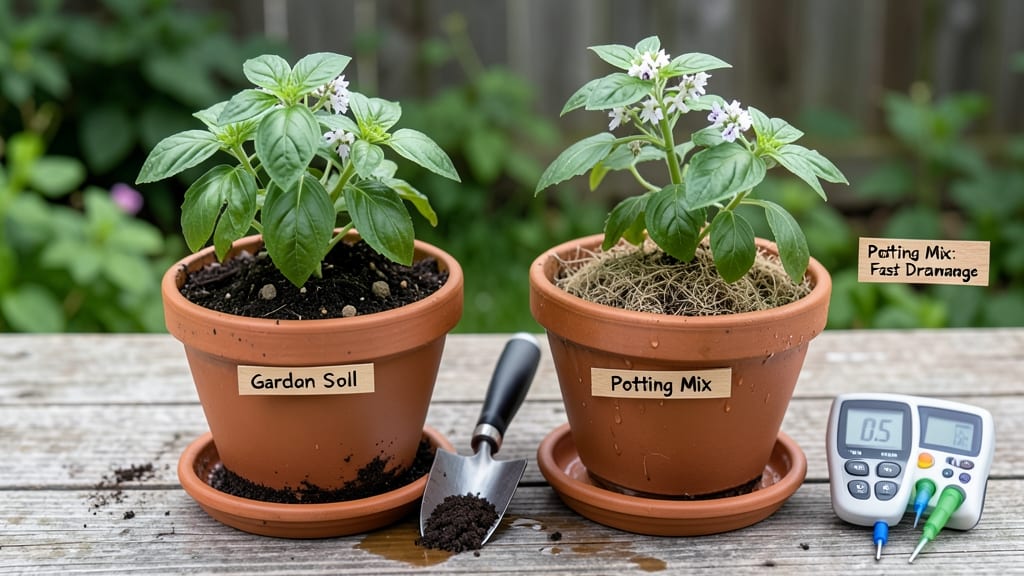
You shouldn't use garden soil for potting because it compacts easily, lacks drainage, and may contain pests or diseases. Instead, opt for lightweight potting mixes with perlite, vermiculite, or coconut coir for healthier plant growth and proper aeration.
Garden soil isn't designed for containers—its heavy clay content breaks down over time, suffocating roots by preventing airflow and water drainage. 🌱 Many garden soils also harbor weeds, pathogens, or larvae that can harm your plants.
I've seen potted plants thrive in commercial mixes because they're formulated with ingredients like peat moss or bark to maintain structure and moisture balance, which garden soil simply can't replicate.
For container gardening, consider pre-mixed blends or create your own by combining equal parts coconut coir, perlite, and compost. This DIY approach gives you control over drainage while supporting microbial activity that garden soil often lacks.
Always choose mixes labeled for your specific plant type—succulents need gritty mixes, while herbs prefer richer, moisture-retentive options.
💡 In This Article
- Why Garden Soil Fails as Potting Mix
- Best Potting Soil Alternatives for Healthy Plants
Why garden soil fails as potting mix
Garden soil is designed for in-ground planting where roots can spread freely, but containers create a completely different environment. The biggest issue is texture: garden soil contains dense clay particles that pack tightly when wet, reducing pore space by up to 70%.
This compaction suffocates roots by blocking oxygen flow—healthy potting mixes maintain 30-40% air space for proper respiration. 🌱 Without this aeration, roots can't absorb nutrients efficiently, leading to stunted growth or root rot.
The organic matter in garden soil also breaks down much faster in containers due to higher temperatures and limited space. What starts as nutrient-rich compost can turn into a dense, waterlogged mess within weeks, creating anaerobic conditions that promote harmful bacteria.
Potting mixes use stabilized ingredients like sphagnum peat moss or coconut coir that resist rapid decomposition while maintaining structure. Even the moisture balance shifts—garden soil holds water like a sponge, while potting mixes release excess water through drainage holes, preventing soggy roots.
Pest and disease risks are another critical factor. Garden soil often contains weed seeds, fungal spores, and larvae that thrive in the confined space of pots. I've seen fungal gnats infestations spread rapidly in garden soil mixes because their larvae feed on decaying organic matter.
Commercial potting mixes are typically pasteurized to eliminate these contaminants, giving your plants a clean start. The nutrient profile also differs—garden soil provides a broad spectrum of minerals, while potting mixes are formulated with balanced, slow-release fertilizers tailored to container gardening needs.
Let's talk about the physical stress on plants. When roots can't expand freely in compacted soil, they grow in tight circles—a condition called circling roots—which strangles the plant as it outgrows its container.
This is why professional mixes include perlite or vermiculite (up to 20-30% of the blend) to create air pockets and prevent this root binding. Without these amendments, even healthy plants will struggle to access water and nutrients efficiently, leading to yellowing leaves or poor flowering.
Consider this real-world example: I once tried growing basil in garden soil versus a commercial potting mix. The basil in garden soil showed signs of stress within two weeks—leaves curled and turned yellow—while the basil in potting mix thrived with vibrant green leaves and strong growth.
The difference came down to the soil's ability to support root expansion and maintain proper moisture levels without becoming waterlogged. 💫
For container gardening, think of potting mix as a specialized ecosystem designed for vertical growth. Garden soil is like trying to grow a tree in a shoebox—it might survive for a while, but it'll never reach its full potential.
The right mix gives roots the space and conditions they need to explore and thrive in the limited volume of pots.