
Container Gardens
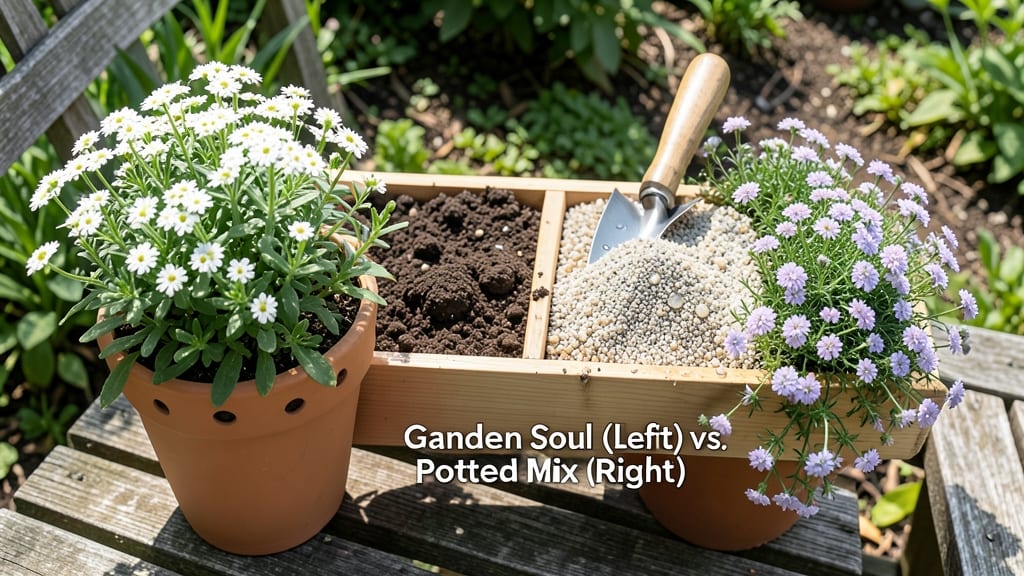
Garden soil can be used in pots only after amending it with sand, compost, and perlite to improve drainage and aeration, but unmodified garden soil risks root rot, compaction, and pest infestations. Always use containers with drainage holes.
Garden soil's heavy clay content and lack of organic matter make it a poor choice for containers, as it compacts easily and suffocates roots. 🌱 To repurpose it, mix in 20-30% coarse sand or perlite for drainage and 30-40% compost for nutrients.
This DIY blend mimics commercial potting mixes better than raw garden soil, though it still won't match their precise aeration. For delicate plants like succulents or orchids, I recommend sticking to store-bought mixes entirely—they're formulated to prevent the very issues garden soil causes.
What many gardeners overlook is that even amended garden soil may still harbor weed seeds or pathogens from your yard. Sterilizing the mix with heat or a 10% hydrogen peroxide solution before use can help, but this adds extra steps.
I've found that container-specific mixes (like those labeled for herbs or vegetables) often provide the best results with minimal effort, saving time and reducing risk.
💡 In This Article
- Why Garden Soil Fails in Containers
- How to Repurpose Garden Soil for Pots Safely
Why garden soil fails in containers
Garden soil's heavy clay or silt content creates a dense, compacted structure that suffocates roots by blocking oxygen flow. Unlike loose potting mixes designed for containers, garden soil holds 10-20% more water by volume, creating anaerobic pockets where roots rot.
The ideal potting mix has 30-50% air space—something garden soil simply can't provide without major amendments. 🌱
Nutrient imbalances are another issue: garden soil often lacks the balanced micronutrients found in commercial mixes. While it may contain plenty of nitrogen from decomposed organic matter, it frequently lacks phosphorus and potassium in the right proportions for container-grown plants.
This imbalance can lead to stunted growth or leaf discoloration, even when plants appear to be getting enough water. The slow nutrient release in garden soil also means plants experience more feast-or-famine cycles compared to the steady release from compost-based potting mixes.
Pest and disease risks multiply in potted garden soil because it often contains dormant weed seeds, fungal spores, and insect eggs from your yard. Unlike sterilized potting mixes, garden soil provides a perfect breeding ground for these problems.
I've seen cases where garden soil in pots led to sudden aphid infestations or powdery mildew outbreaks within weeks—problems that rarely occur with fresh commercial mixes. The confined space of containers makes these issues even more problematic since there's no escape route for affected plants.
Texture plays a critical role too. Garden soil's fine particles pack tightly when watered, creating a brick-like consistency that restricts root expansion. In contrast, potting mixes incorporate coarse materials like perlite or bark fines to maintain loose structure.
This difference is why plants in garden soil often develop shallow root systems that can't access nutrients efficiently, leading to nutrient deficiencies despite the soil's appearance. 🌿
For example, try growing basil in unamended garden soil versus a quality potting mix. The basil in garden soil will wilt faster between waterings and develop yellow leaves from nutrient lockout, while the same plant in a proper mix thrives with vibrant green leaves and continuous flowering.
This dramatic difference illustrates how soil structure directly impacts plant health in containers.
The key takeaway is that garden soil's natural properties make it fundamentally unsuitable for containers unless heavily modified. Its density, water retention, and pest risks create an environment that stresses plants in ways they wouldn't experience in garden beds.
The science is clear: container gardening requires a fundamentally different soil composition to succeed.