
Tools
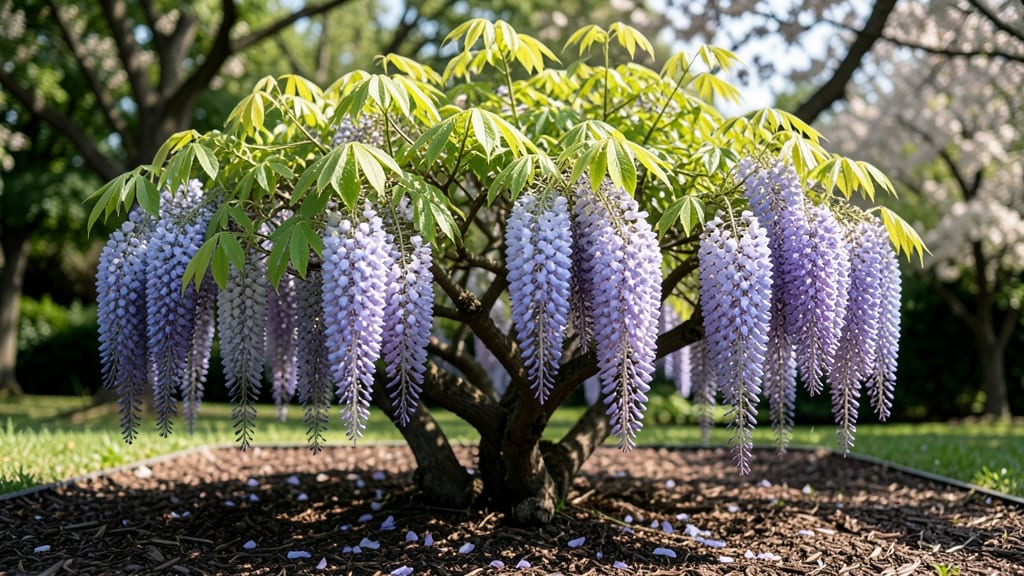
Wisteria in Japanese gardens represents humility, resilience, and fleeting beauty through its delicate lavender blooms, often shaped into elegant cascades for sacred spaces like temple courtyards and tea houses. These fragrant vines celebrate spring's arrival while embodying Zen philosophies of impermanence and natural harmony.
Japanese gardeners have cultivated wisteria (fuji in Japanese) for centuries, prizing its ability to transform bare branches into vibrant floral displays that evoke both spiritual and seasonal renewal. 🌸 The vines' rapid growth symbolizes perseverance, while their ephemeral blooms remind practitioners of life's transient nature—a core concept in Zen Buddhism.
Many traditional gardens incorporate wisteria near water features or stone paths to enhance its poetic quality, creating spaces that feel both meditative and visually stunning.
Beyond symbolism, wisteria's practical cultivation requires patience and skill. The most prized varieties for Japanese gardens, like Wisteria floribunda, need strong support structures to achieve their iconic draping forms.
Pruning in late winter is essential to maintain both shape and health, while pairing with elements like bamboo or moss further enhances the garden's natural aesthetic. This combination of cultural meaning and horticultural technique makes wisteria a cornerstone of Japanese garden design.
💡 In This Article
- Symbolic Meanings of Wisteria in Japanese Culture
- How to Cultivate Wisteria for Japanese Garden Design
Symbolic meanings of wisteria in Japanese culture
Wisteria's cultural significance in Japan stems from its perfect embodiment of mono no aware—the bittersweet awareness of impermanence.
The vines' dramatic seasonal transformation from bare branches to lavender-purple blooms (called harusame or "spring rain") visually represents life's fleeting nature, a concept central to Zen Buddhism. 🌸 During the Edo period (1603-1868), wisteria became associated with aristocratic gardens where scholars would compose poetry beneath its fragrant canopies, linking it to intellectual and spiritual pursuits.
The vines' humble origins—growing from simple roots yet reaching towering heights—mirror the Buddhist ideal of enlightenment through perseverance. In temple gardens, wisteria's cascading forms often frame stone lanterns or water features, creating visual metaphors for spiritual clarity.
The blooms' intense fragrance, described in haiku as "the scent of a thousand prayers," enhances this sacred connection during Hanami festivals where families gather to appreciate spring's ephemeral beauty.
Historically, wisteria's symbolism extended to samurai culture as a metaphor for resilience.
The vines' ability to thrive even when pruned aggressively reflected the warrior ethos of discipline and renewal. 🌿 Ukiyo-e artists like Hiroshige frequently depicted wisteria in woodblock prints, often placing it near cherry blossoms to contrast fleeting beauty with enduring strength—a visual narrative that continues influencing modern Japanese aesthetics.
Seasonal traditions further cement wisteria's cultural role. In Kyoto's Philosopher's Path, the vines' blooming coincides with late April to early May, marking the transition from winter's dormancy to spring's vitality.
This timing aligns with Bodhi Day (April 8th), when Buddhists celebrate enlightenment, creating a natural synergy between nature's cycles and spiritual observances. The vines' 10-15 foot annual growth also symbolizes rapid spiritual progress, a concept celebrated in Zen gardens.
Modern interpretations maintain these themes while adapting to contemporary spaces. Urban gardens now incorporate dwarf varieties like Wisteria brachybotrys (Japanese wisteria) that bloom earlier (March-April) and produce 1-2 inch flowers, perfect for smaller courtyards.
These adaptations preserve the plant's symbolic essence while making its benefits accessible to city dwellers seeking mindfulness in limited spaces. 💫
The vines' biological characteristics—like their self-pruning nature (dropping old wood annually)—further reinforce their symbolic meaning. This natural cycle mirrors the Buddhist concept of dependent origination, where all things arise in dependence on causes and conditions, emphasizing interconnectedness.
Gardeners often position wisteria near stone paths to guide visitors through meditative reflection, creating physical pathways that parallel spiritual journeys.