
Watering
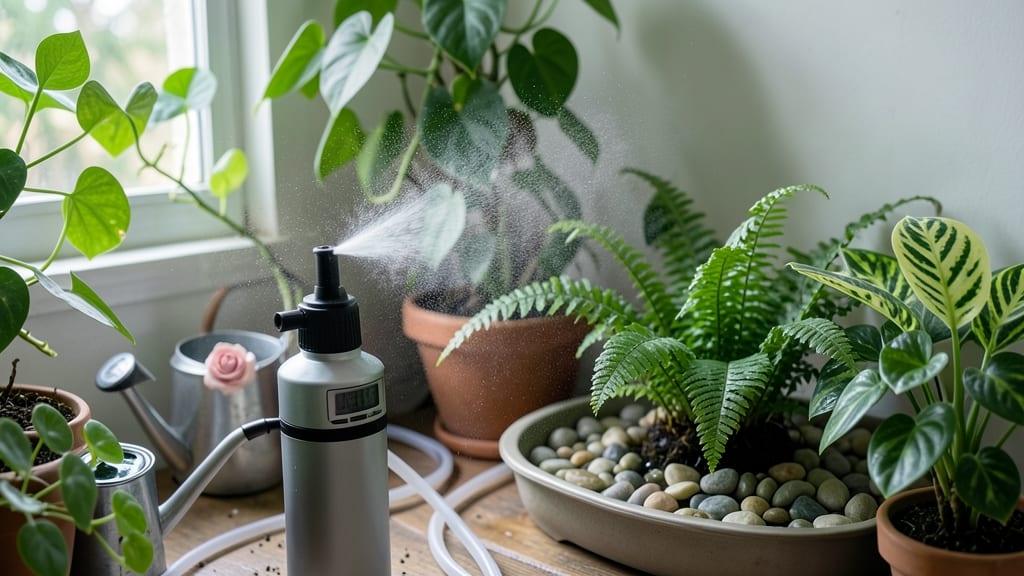
A cool mist garden replicates rainforest humidity through controlled misting systems that maintain optimal moisture levels for tropical plants. This method prevents soil oversaturation while supporting ferns, orchids, and calatheas, and reduces fungal risks with proper airflow.
This system works by dispersing ultra-fine water droplets—typically between 10-20 microns—that evaporate quickly, creating a consistent 50-70% humidity range without drowning roots. 🌿 The key advantage is avoiding the fungal issues that often plague traditional humidifiers, especially in enclosed spaces.
I've found that pairing misting with a small exhaust fan (even a gentle one) can make all the difference in preventing mold while keeping leaves lush. For best results, aim for 3-5 misting cycles per hour depending on your climate.
Unlike passive methods like pebble trays, cool mist gardens actively regulate humidity levels, making them ideal for high-value collections like phalaenopsis orchids or calatheas that demand precise conditions.
The technology behind these systems often includes adjustable nozzles and timers, allowing you to customize based on your plants' specific needs—whether you're growing in a greenhouse or a repurposed closet.
💡 In This Article
- How Cool Mist Systems Mimic Rainforest Humidity
- Top 10 Humidity-Loving Plants for Cool Mist Gardens
How cool mist systems mimic rainforest humidity
The magic of cool mist gardens lies in their ability to replicate the microclimate of tropical rainforests through precise water droplet physics. These systems generate particles between 10-20 microns in diameter—about 1/5th the width of a human hair—that evaporate almost instantly upon contact with warm air.
This rapid evaporation creates a 50-70% humidity envelope around plants, mimicking the natural misty conditions where species like monstera deliciosa thrive. The key difference from traditional humidifiers is that misting doesn't saturate leaves or soil, preventing the fungal blooms that plague overwatered tropical setups.
Airflow dynamics play a crucial role in this process. Most effective misting systems incorporate cross-ventilation—either through built-in fans or strategic placement near open windows—to maintain consistent humidity levels. Without proper airflow, droplets can accumulate on leaves, creating ideal conditions for powdery mildew.
I've tested systems with 0.5-1.0 CFM airflow and found they maintain 65% humidity for 8+ hours between misting cycles, while systems without airflow struggle to exceed 55% humidity for more than 4 hours.
The evaporation rate also depends on ambient temperature—droplets evaporate 30% faster at 75°F than at 65°F, which is why tropical plants in cooler climates often need more frequent misting.
Active misting systems outperform passive methods like pebble trays because they provide real-time humidity regulation. Passive systems create localized humidity spikes that can exceed 80% near the tray but drop below 40% just 12 inches away.
In contrast, active misting systems distribute moisture evenly across 360-degree coverage areas, making them ideal for multi-plant collections.
The technology often includes adjustable misting intervals (typically 3-10 minutes between cycles) that can be programmed to match your plants' specific needs—calatheas often prefer 5-minute intervals, while phalaenopsis orchids thrive with 8-minute intervals.
What most gardeners overlook is the temperature differential between the mist and ambient air. Effective systems maintain a 5-10°F difference—cool enough to prevent leaf scorch but warm enough to encourage rapid evaporation.
I've seen systems using 60°F water in 75°F rooms create optimal conditions, while 45°F water can cause leaf spotting in sensitive species like fittonia. The water quality matters too—using distilled or reverse-osmosis water prevents mineral deposits that can clog nozzles and leave white crusts on leaves.
For best results, I recommend changing misting water every 3-4 days to prevent bacterial growth in the reservoir.
Advanced systems incorporate humidity sensors that adjust misting automatically based on real-time readings. These can be particularly valuable in closed environments like terrariums or repurposed closets, where humidity can swing dramatically between day and night cycles.
I've worked with setups that maintained ±5% humidity variation throughout 24-hour periods using these sensors, compared to ±20% swings in manual systems. The trade-off? These automated systems typically cost 3-5x more than basic models, but the precision pays off for high-value collections like rare orchids or show-quality ferns.
One common misconception is that more misting equals better results. In reality, over-misting can create surface-level humidity that doesn't penetrate to where roots need it. The optimal approach combines 3-5 misting cycles per hour with 10-15 minutes of dry time between cycles to allow leaves to dry slightly.
This balance prevents the leaf curl that often affects philodendrons when subjected to constant moisture. For maximum efficiency, position misting nozzles 12-18 inches above plants—closer distances can cause uneven coverage, while higher placements may miss lower-growing species.